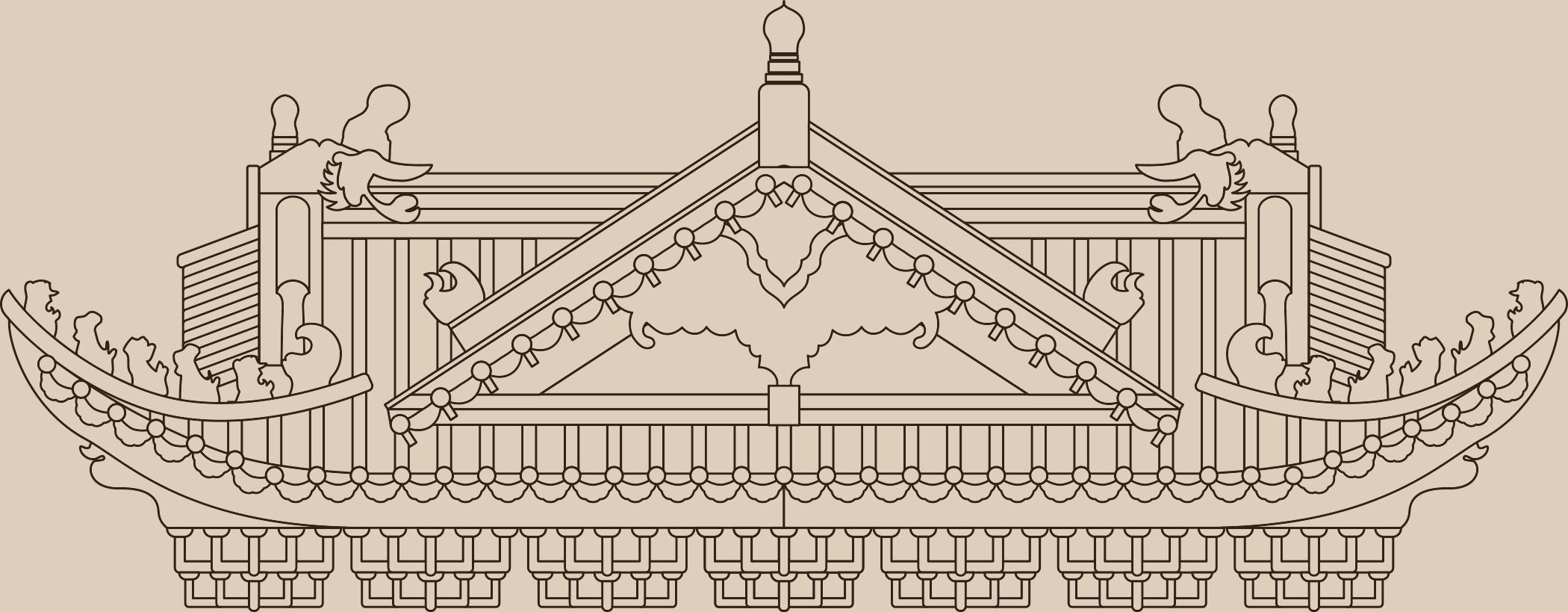
The cloister is a hallmark of Tung Lin Kok Yuen, a rare architectural feature seldom seen in other monasteries. From within the cloister, visitors can enjoy a commanding view of the interior architecture and treasured artifacts of the main hall. Elegantly constructed along the inner walls of the main hall, the cloister forms an elliptical pathway that gradually narrows, harmonizing with the arrowhead-shaped contours of the site. Its design is further distinguished by red wooden railings, exquisitely adorned with intricate swastika-inspired patterns, culminating in a space of unparalleled refinement and uniqueness.
Buddhist banners and streamers are traditional decorative elements, known as dhvaja and ketu. A “banner” refers to a flag designed to be flown, while a “streamer” is a long, vertically hanging flag. At TLKY, these banners and streamers are elegantly suspended from the ceiling, each inscribed with the names of Buddhas from all directions: East, South, West, North, as well as above and below. This arrangement symbolizes the infinite reach and omnipresence of the Buddha’s teachings throughout the ten directions.
From the vantage point of the cloister, the majestic plaques adorning the spaces above the Main Hall and the Guanyin Hall come into full view: “Merciful Clouds Enveloping” and “Benevolent Clouds of Blessings”. The first was inscribed and graciously gifted by Zhang Xueliang, while the second showcases the refined calligraphy of Xu Shichang.
Decorative lines and a palette of beige, green, red, and blue adorn the architecture over the cloister, reflecting traditional Chinese design elements. Neatly arranged red and blue squares positioned on the roof resemble Chinese-style dougong brackets, serving a purely decorative purpose without any load-bearing function. The walls on both sides, along with the wooden beams above, are intricately embellished with red-and-blue “Ruyi” pattern motifs.
In the 1930s, the cloister functioned as a temporary classroom, later serving as a refuge for displaced individuals during the Japanese occupation and a study space for Po Kok Buddhist Seminary students.