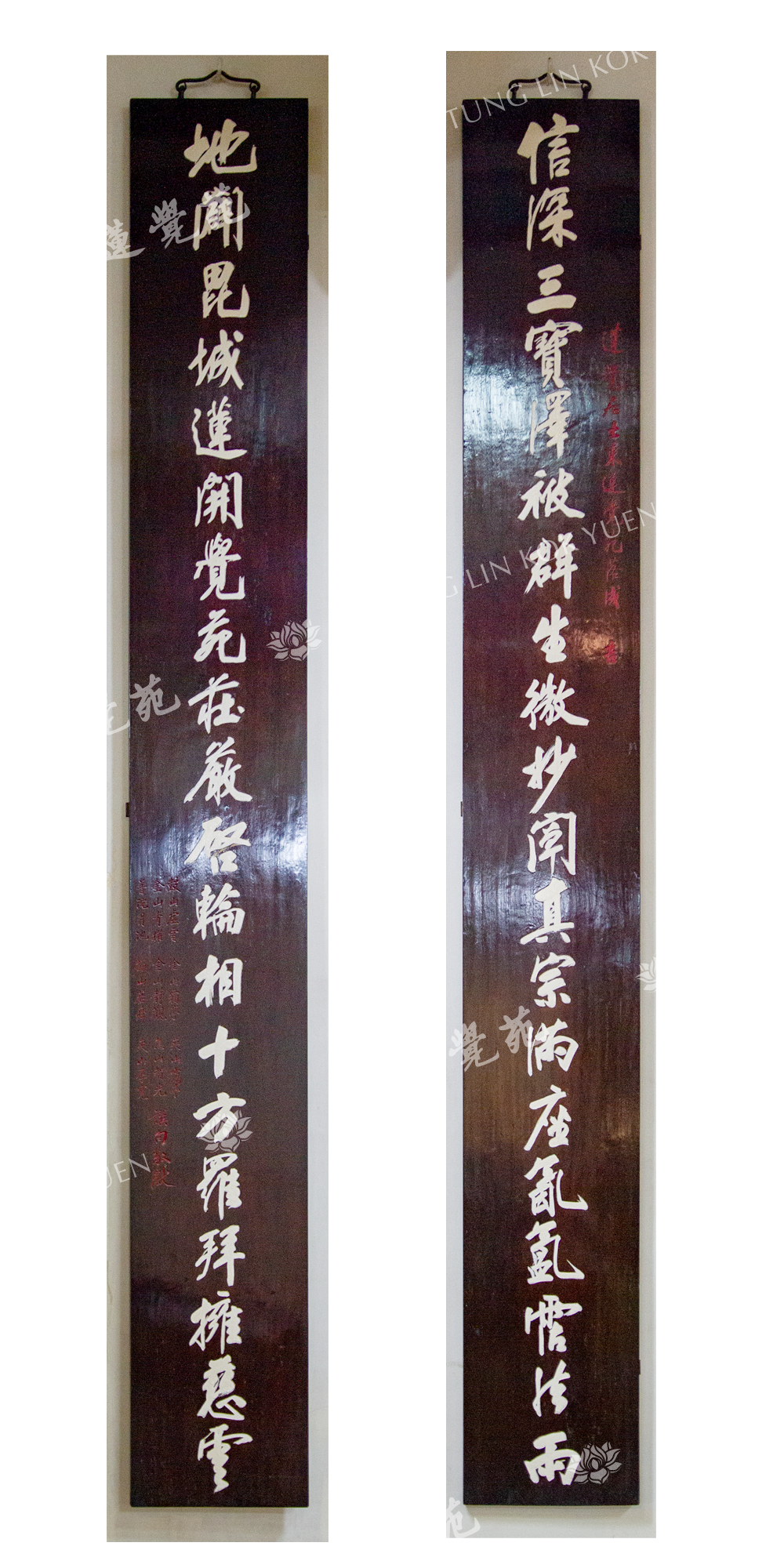
Bathed in the Profound Grace of the Three Buddhas, All Beings Are Blessed, Subtle Truths Revealed, the Faithful Gathered, Immersed in Misty Clouds and Dharma’s Rain.
The Land Unfolds, Kapilavastu Blossoms with a Garden of Awakening, Majestic and Pure, the Dharma Wheel Turns, as Ten Directions Bow in Reverence Beneath Compassion’s Cloud.
Venerable Xu Yun made several visits to Hong Kong to promote the Dharma. In April 1935, at the invitation of the Tung Wah Group of Hospitals, he travelled to Hong Kong to guide the establishment of a Water and Land Dharma Assembly ceremonial site at Tung Lin Kok Yuen. In conjunction with the completion of the newly constructed TLKY, Master Xu Yun inscribed a plaque for the Grand Buddha Hall, naming it “Source of the Dharma Flows Eastward,” and composed a commemorative couplet to mark the occasion.
The upper verse of the couplet highlights the “Three Buddhas”—the Buddha, the Dharma, and the Sangha. The term “misty clouds” symbolizes an atmosphere of transcendence and profundity, while “Dharma rain” represents the life-giving nectar of the Buddha’s teachings. This verse underscores the importance of deep faith in the Three Buddhas, the practice of compassionate efforts to benefit and liberate all sentient beings, and the promotion of authentic Buddhist teachings, enabling all who gather within the ceremonial site to experience the joy of the Dharma.
The lower verse references Kapilavastu, the birthplace of the Buddha. The “wheel mark” is one of the Buddha’s thirty-two distinguishing physical characteristics, referring to the wheel-like imprint on the soles of his feet. The term “reverence” signifies the devoted prostrations of followers. This verse portrays Kapilavastu as the birthplace and origin of Buddhism, while recognizing TLKY in Hong Kong as a continuation of this sacred Dharma lineage. Within the ceremonial site, the solemn and dignified images of the Buddha inspire devotees from all directions to gather, offer worship, and uphold the Dharma.