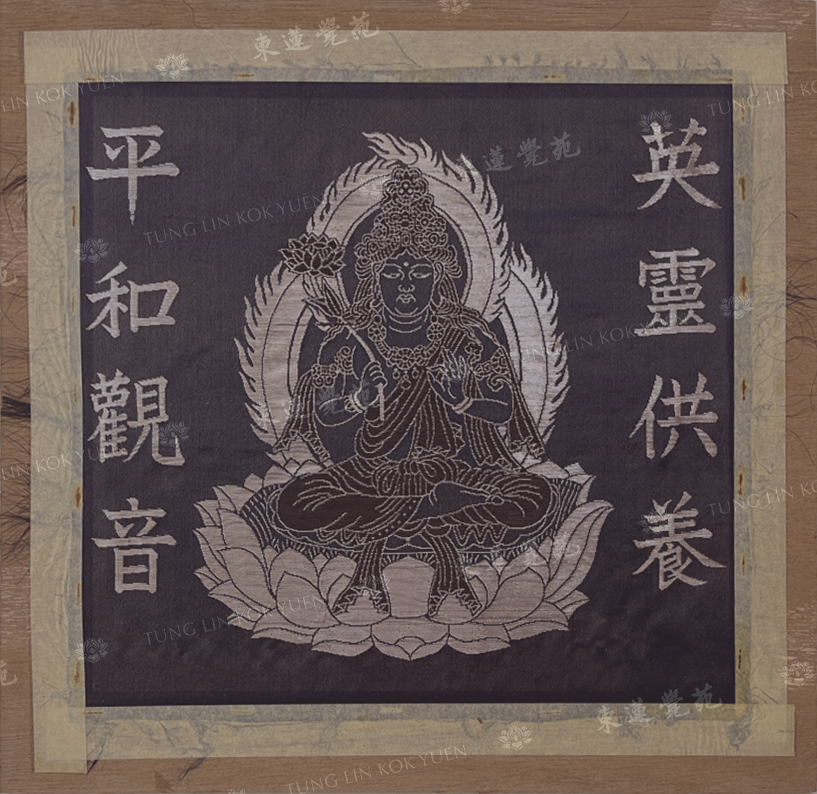
To repent for Japan’s atrocities during its occupation of Hong Kong, a group of devout Japanese Buddhist laywomen cut their hair to weave a one-square-foot “Hair Mandala Guanyin” image, symbolizing their sincere apology and deep remorse.
In June 1954, Sasaki Taiō, Chairman of the Japanese Buddhist Federation, and Takashina Rosen, Head Priest of Sōtō Zen Buddhism, presented the sacred image to Hong Kong. It was solemnly received by Madam Lam Ling Chun, Abbot of Tung Lin Kok Yuen, as a gesture of goodwill and repentance.
Accompanying the “Hair Mandala Guanyin” was an interpretation written in both Chinese and English, which reads: “With devotion, pious Japanese laywomen offered their hair to weave this sacred Avalokiteshvara image, honouring those who perished in World War II and repenting for the suffering caused in this land. The offering includes a prayer: ‘May the world know peace and stability, may all conflicts cease, and trusting in the Tathagata’s teachings, I bow in homage.”
The inscription was signed by Takashina Rosen, Head Priest of Sōtō Zen, and Sasaki Taiō, Chairman of the Japanese Buddhist Federation, in June of the Year of Jiawu (1954).