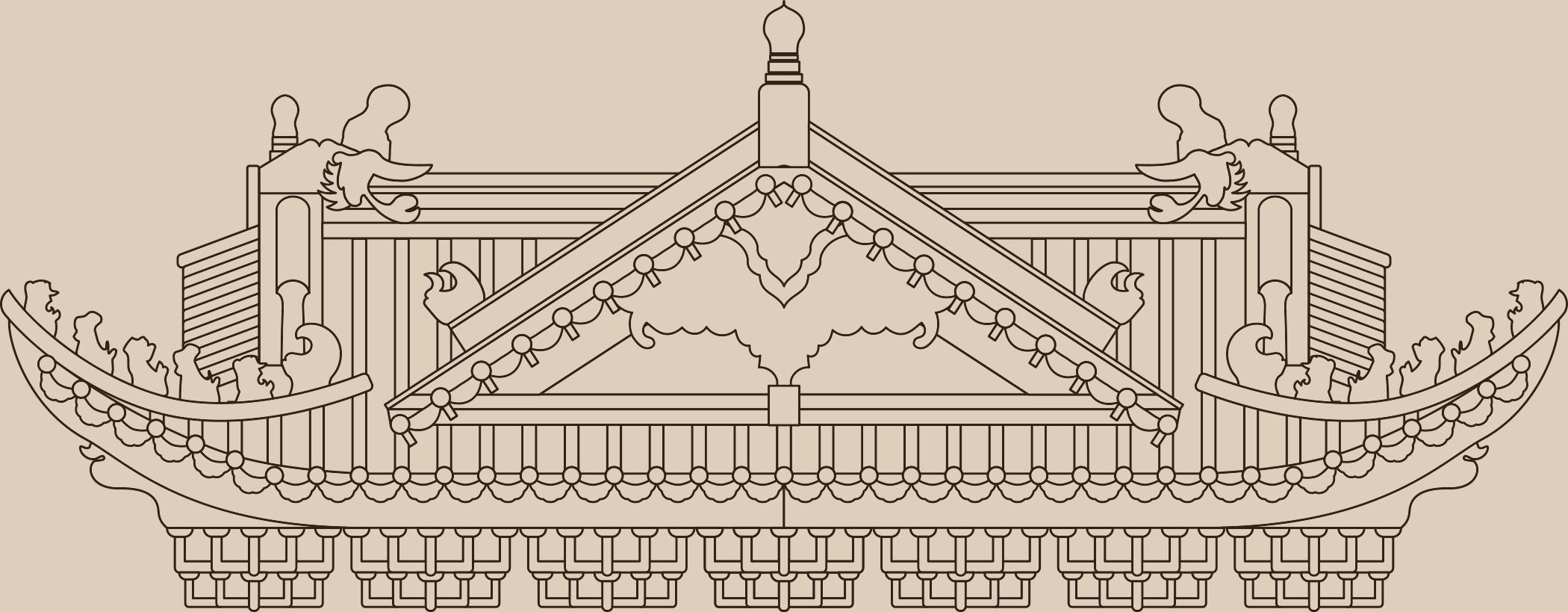


Ninety years ago, the rural landscapes of Hong Kong provided a serene refuge where Buddhist monks dwelled in quiet seclusion, their lives devoted to the farming-Zen tradition. In harmony with nature, they cultivated the soil, embodying simplicity, self-sufficiency, and spiritual devotion. In 1933, this tranquil way of life underwent a momentous transformation. Lady Clara Ho Tung, guided by visionary purpose, acquired a plot of land in Happy Valley through auction. This significant acquisition symbolized a luminous new chapter in the unfolding tapestry of Buddhism, marking a graceful transition from the serene refuge of rural landscapes to the vibrant heartbeat of Hong Kong’s urban panorama.
Sir Robert Ho Tung and his esteemed wife fostered boundless goodwill, inspiring numerous renowned figures to gift plaques and couplets to Tung Lin Kok Yuen. These inscriptions and calligraphy reflect the Yuen’s history and development while serving as invaluable cultural artifacts.
Completed in 1935, TLKY embodies the spirit of “Modern Learning, Traditional Practice,” with a mission to relieve suffering, promote joy, and advance Buddhism in modern times through widespread Dharma propagation. As one of the few urban Buddhist monasteries of its time, it actively organized courses, lectures, and events, inviting renowned masters such as Venerable Tai Xu, Xu Yun, Ding Xi, and Yue Xi to share their teachings. For instance, Venerable Tai Xu lectured on “Upasika Education and the Buddhist Family,” while Professor Xu Dishan delivered a Cantonese talk on “Buddhism and Moral Life” to address societal needs. Ever committed to Buddhism, TLKY continued hosting lectures and events and, in the 1950s and 1960s, served as the meeting venue for the newly established Hong Kong Buddhist Association, welcoming distinguished prominent monastic.
For 90 years, TLKY has been committed to serving society, beginning with its inaugural collaboration with the Tung Wah Group of Hospitals to organize Hong Kong’s first large-scale Buddhist ceremony, the “Charitable assembly of ten thousand people (Wanrenyuanhui),” honoring war victims and praying for peace. During the Japanese occupation, it provided relief by distributing food and offering shelter to the homeless, and in 1963, during Hong Kong’s drought, it joined the Hong Kong Buddhist Association’s rain-seeking ceremony at Happy Valley Racecourse to address the water crisis. In recent years, the sanctuary has expanded its efforts beyond Happy Valley, maintaining the Tsuen Wan Tung Lin Kok Yuen Wang Fat Ching She and establishing the modern Dharma center “Tung Lin Kok Yuen Cloud Haven” in Chai Wan to ensure its work remains relevant to Hong Kong society. In 1994, it established the Tung Lin Kok Yuen, Canada Society in Vancouver, and following the reconstruction of Wang Fat Ching She in Tsuen Wan, it partnered with Centre of Buddhist Studies, The University of Hong Kong to establish the “TLKY-HKUCBS Buddhist Counselling Centre,” promoting the practical application of Buddhist teachings through internships, research, and counseling programs.
